
Vegetables
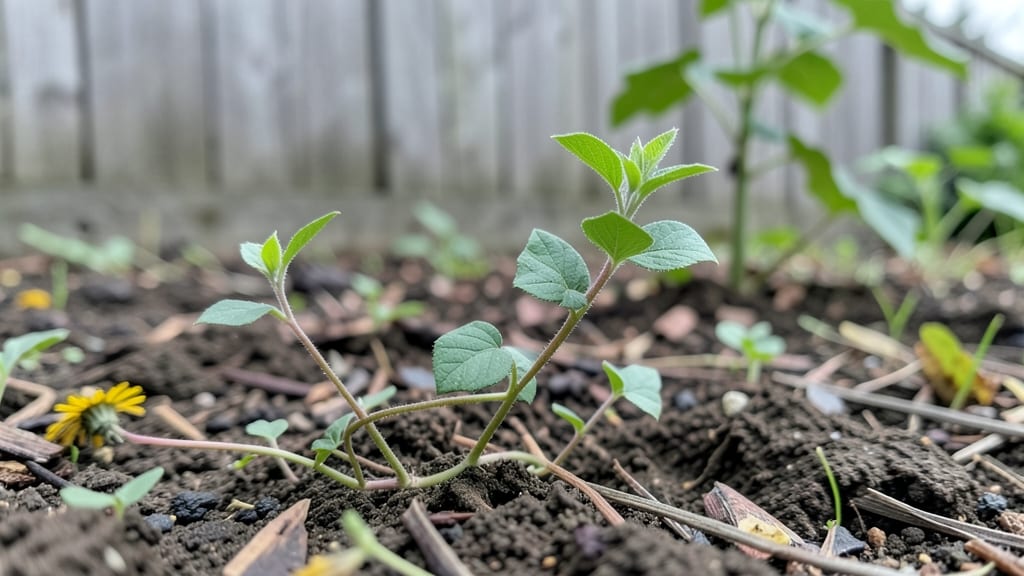
Identifying black bindweed seedlings starts with their distinctive arrowhead-shaped leaves featuring pointed lobes and a glossy dark green finish, combined with smooth, hairless stems that spiral clockwise as they mature. These aggressive vines grow rapidly and develop deep roots, setting them apart from other garden weeds.
Black bindweed seedlings are often mistaken for harmless vines, but their clockwise twining habit and deep taproots make them one of the toughest garden invaders. 🌱 Unlike morning glory, which has heart-shaped leaves, black bindweed's pointed lobes and silky stems create a telltale pattern when viewed closely.
I've found that checking garden beds in early spring—before vines reach 6 inches—gives you the best chance to pull them before their roots take hold.
What makes these seedlings particularly tricky is their ability to regrow from even small root fragments, so proper removal requires digging at least 12 inches deep.
A pair of gardening gloves and a sturdy trowel become essential tools when dealing with established plants, as their vines can reach lengths of 10 feet in a single season.
The key is acting fast—once you spot those signature arrowhead leaves, you know you're dealing with black bindweed and should treat it as an emergency garden cleanup.
💡 In This Article
- Distinguishing Black Bindweed Leaves from Other Weeds
- Early Detection Tips for Black Bindweed in Gardens
Distinguishing black bindweed leaves from other weeds
Black bindweed seedlings stand out from common garden vines thanks to their arrowhead-shaped leaves with three to five pointed lobes that create a distinct triangular outline.
Unlike morning glory's smooth heart-shaped leaves or wild cucumber's lobed, hairy foliage, black bindweed leaves have smooth edges and a shiny, almost waxy surface that reflects light differently. The leaf veins form a prominent V-pattern from the central stem, which helps distinguish them from similar weeds when examined closely.
The stem texture is another key identifier: black bindweed stems are completely hairless and smooth, while wild cucumber stems often have soft hairs along their length. This smoothness extends to the twining habit—black bindweed vines always spiral clockwise around supports, whereas morning glory vines can twine either direction.
The stems also lack the rough, ridged texture found on some smartweed varieties, making them easier to identify when pulled from the soil.
When comparing to morning glory, the most reliable difference is the leaf attachment: black bindweed leaves grow in pairs directly opposite each other on the stem, while morning glory leaves alternate in a spiral pattern.
The glossy dark green color of black bindweed leaves also sets them apart from the lighter, matte green of wild cucumber seedlings. These visual distinctions become especially clear when examining young plants before their vines mature and intertwine with other garden plants.
For gardeners dealing with potential infestations, the leaf arrangement and stem hair presence provide a quick field test. Simply run your fingers along the stem—if it feels completely smooth and the leaves grow in opposite pairs with pointed lobes, you're likely dealing with black bindweed.
This tactile identification method works particularly well in early spring when seedlings are still small, before their vines become tangled with other plants in the garden bed.
The vein pattern also reveals important clues: black bindweed leaves have three primary veins extending from the base, creating that signature arrowhead shape. In contrast, wild cucumber leaves typically show five to seven veins radiating from the center.
This difference becomes apparent when holding leaves up to natural light, where the vein structure casts subtle shadows that highlight the distinct patterns.
What most gardeners don't realize is how the leaf orientation changes as the plant matures. Young seedlings have nearly perfect arrowhead shapes, but as vines grow, the leaves may become more asymmetrical due to shading and competition.
However, the stem twining direction remains consistently clockwise throughout the plant's life cycle—a reliable characteristic even when leaves show signs of stress or damage.